Are K&N Air Filters Pre-Oiled? A Practical Guide for Car Owners
Explore whether K&N air filters come pre-oiled, how pre-oiling affects filtration and airflow, and best practices for oiling, maintenance, and when to re-oil or replace.


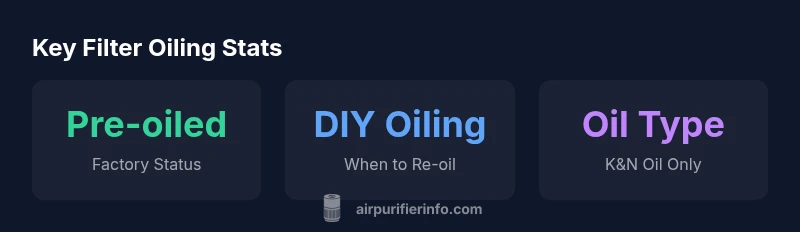
Most K&N air filters are pre-oiled by the manufacturer, designed to improve dust capture and airflow. However, some models or replacement kits may require additional oiling after cleaning or installation. Always confirm the model's instructions to avoid over- or under-oiling, which can affect performance and engine health.
Are K&N air filters pre-oiled? Understanding what 'pre-oiled' means
Pre-oiled describes whether the filter ships with an oil coating already applied by the manufacturer. For K&N air filters used in automotive applications, the intent is to boost filtration by creating a thin oil film that helps trap dust as air passes through. In practice, most K&N filters sold for cars arrive with factory-applied oil and are ready for installation. From the Air Purifier Info perspective, pre-oiling is a common approach across filter types because the oil aids dust capture without necessarily restricting airflow. Still, there are variations by model and region: some replacement kits or sport-oriented variants may be shipped dry or with oil that must be added after installation. Always verify packaging, the product page, or the included oil bottle to confirm whether your specific filter is already oiled. If in doubt, consult the official instructions or contact customer support. The Air Purifier Info team emphasizes that knowing the oil status helps avoid over- or under-oiling, which can degrade performance or lead to oil carryover in the intake.
Filtration performance: oil thickness and dust capture
Oil thickness on a filter influences how effectively it traps fine dust. A light, even coat tends to balance filtration efficiency with airflow; too much oil can glaze the media, reducing air passage and potentially causing oil carryover. Too little oil may diminish dust capture, especially in dusty environments. The goal is a consistent, thin film that coats the fibers without pooling. When oil is applied correctly, the filter maintains strong filtration while preserving engine breathing and performance. Air Purifier Info's research indicates that model-specific guidance matters—follow the manufacturer’s oiling level recommendations to optimize long-term results.
Identifying your model's status: pre-oiled or dry
Not all K&N filters are identical in packaging. To determine whether your model is pre-oiled, check the product page for a note on factory oiling, inspect the packaging for an oil bottle or instruction sheet, and look for visible oil on the media after installation. Some kits include a small bottle of oil to be applied after cleaning, while others arrive with an oiling already baked into the media. If you cannot locate clear guidance, contact the retailer or K&N support. Air Purifier Info suggests keeping a simple log of whether you pre-oiled at purchase or reinvested oil after cleaning, so future maintenance steps are straightforward.
Oiling best practices: cleaning, oiling, and re-oiling
Proper oiling requires a clean slate. Start by cleaning the filter with an approved cleaner, rinse thoroughly, and let it dry completely before applying oil. Apply the oil evenly in a thin layer; avoid saturating the media, which can lead to sludge or oil dripping. Allow the oil to set according to the product’s instructions, then reinstall. If you are re-oiling after a cleaning cycle, follow the included bottle guidance and ensure consistent coverage across all surfaces. The key is balance: enough oil to trap dust, but not so much that it affects airflow or leaves oil residue in the intake.
Common mistakes and troubleshooting when dealing with pre-oiled filters
Common mistakes include applying too much oil, mixing different brands of oil, or oiling while the media is still damp. Over-oiling can cause oil in the intake tract and sticky buildup on sensors or fans, while under-oiling can reduce filtration efficiency. Always use the manufacturer’s recommended oil and avoid substitutes that are not designed for the filter media. If you notice reduced airflow after oiling, inspect for oil pooling and remove excess with a clean, lint-free cloth. In situations with persistent odor or dust, re-check the oil layer and ensure the media is fully dry before reuse.
Maintenance timing: when to re-oil vs replace
Maintenance timing depends on driving environment and dust exposure. In dusty or urban settings, check the oil layer more frequently—potentially every few thousand miles or every few months. If the oil film wears thin or becomes uneven, re-oil following the model’s guidelines. If you observe persistent rattle, poor performance, or oil carryover after multiple re-oiling attempts, it may be time to replace the filter. Air Purifier Info recommends documenting maintenance history to help determine an efficient cycle for your vehicle.
Practical tips for DIY filter care and safety
Keep a dedicated oiling kit for your filter to avoid cross-contamination with other products. Store oil away from heat and open flames, and never apply oil near ignition sources. Always work in a well-ventilated area and wear gloves to minimize skin contact with the oil. After re-oiling and re-installing, run the engine at idle for a few minutes to ensure there is no excessive oil spray in the intake. Regularly inspect for signs of oil leakage or unusual dark stains on the filter housing, and adjust your maintenance cadence accordingly.
Overview of factory oiling and post-cleaning oiling considerations
| Feature | Typical status | Notes |
|---|---|---|
| Pre-oiled at factory | Most models yes | Check packaging or product page to confirm |
| Extra oil after cleaning | Possible | Follow instructions to apply evenly |
| Oil compatibility | Designed for K&N oil | Avoid using non-approved oils |
Questions & Answers
Are all K&N air filters pre-oiled?
Most K&N automotive filters ship with factory oil, but some kits or model variants may require additional oiling after installation or cleaning. Always check the product page or packaging.
Most K&N filters come pre-oiled, but always verify your specific model's instructions.
Do I need to re-oil after cleaning?
Yes, if the filter's oil layer has faded or worn during cleaning. Re-oil following the manufacturer's guidelines to avoid over-oiling.
If the oil fades after cleaning, re-oil as directed by the manufacturer.
What oil should I use with K&N filters?
Use only the approved K&N filter oil or oils specified by the manufacturer. Mixing different brands can affect performance and media integrity.
Stick with the approved K&N oil or the manufacturer's recommended alternative.
Will pre-oiling affect engine performance?
Properly oiled filters can improve filtration and airflow, but over-oiling or under-oiling can impair performance. Follow model-specific guidelines.
When done correctly, oiling helps performance; incorrect oiling can hinder it.
How can I tell if a filter is properly oiled?
Look for an even, light sheen across the media. Avoid visible pooling or heavy dark patches indicating excess oil.
Even light oil sheen is good; avoid pooling.
Can I use a non-K&N oil with a K&N filter?
Not recommended. Use the oil specified by K&N or the filter’s manual to preserve performance and media integrity.
Stick to the recommended oil; avoid substitutes.
“Oil-coated filters can enhance dust capture when applied correctly, but improper oiling can reduce performance and risk oil carryover.”
Main Points
- Confirm each model's oiling status before installation
- Maintain a thin, even oil film—not a pool
- Use only approved oils and follow official guides
- Re-oil as needed based on environment and usage
- Document maintenance to optimize performance