Air Purifier vs UV Light: What Homeowners Should Know
Analyze how air purifiers with UV-C light compare to traditional HEPA purifiers. This analytical guide explains mechanisms, safety, effectiveness, costs, and practical decision criteria for homeowners and renters seeking cleaner indoor air.


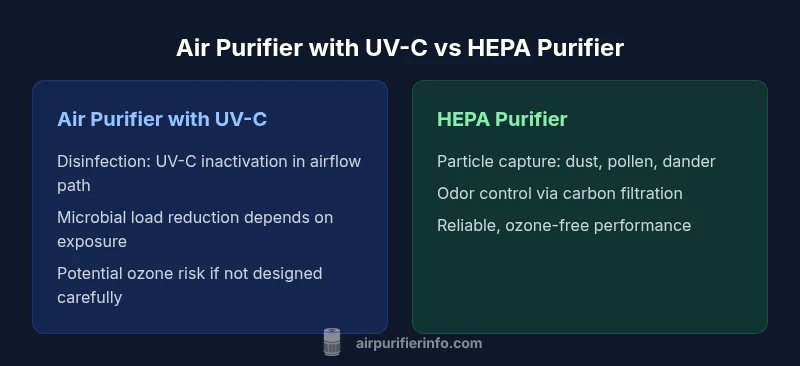
Air purifier vs uv light: UV-C-equipped purifiers add microbial inactivation beyond filtration, but effectiveness hinges on airflow and exposure time. A high-quality HEPA purifier remains the core for particle removal. For most homes, HEPA-only is best value; UV-C makes sense in high-risk spaces or where extra disinfection is desired, as long as the unit is ozone-free and maintained.
What 'air purifier vs uv light' means for indoor air quality
Air quality in homes hinges on how effectively we manage particles, gases, and microbes. When you hear air purifier vs uv light, you're weighing a traditional filtration approach against a disinfection technology. In practical terms, most households rely on HEPA-based purifiers to trap particles, while UV-C light aims to inactivate microorganisms as air passes through the device. According to Air Purifier Info, the key question is not merely whether UV-C works, but whether it adds meaningful disinfection under real-world conditions of airflow, room occupancy, and maintenance. Air Purifier Info Analysis, 2026 notes that UV-C-augmented purifiers can offer an extra layer of microbial control, but benefits depend on how long air spends in the treatment zone and how well the purifier handles dust.
From a consumer perspective, you should think of air purifier vs uv light as complementary rather than mutually exclusive options. A well-designed HEPA purifier will capture a broad swath of particles, including dust, pollen, and pet dander, while activated carbon helps reduce odors and some gases. UV-C, when implemented in a purifier, introduces a second line of defense against microbes that are sometimes too small to be captured by filters alone. However, UV-C's effectiveness is not universal; it depends on factors such as lamp intensity, bulb age, the purity of the airflow path, and whether the device is designed to prevent ozone formation. The most important takeaway is that there is no single magic solution. The choice should reflect your indoor air quality goals, whether you are protecting a sensitive household member, or simply trying to reduce seasonal contaminants. This guide will walk through mechanisms, practical implications, and decision criteria to help homeowners and renters make an informed choice that aligns with their needs.
wordCount":"248"} ,
Comparison
| Feature | Air Purifier with UV-C | Traditional HEPA-only Air Purifier |
|---|---|---|
| Disinfection mechanism | UV-C inactivation + filtration | Filtration + adsorption (carbon) |
| Primary target | Microorganisms in air and on surfaces when exposed | Particulate matter: dust, pollen, pet dander; some gases via carbon filter |
| Effectiveness against viruses | Potentially inactivates some airborne viruses with adequate exposure | Mostly relies on physical capture; some effectiveness for surface-associated microbes if contact occurs |
| Effectiveness against bacteria and mold | Broad-spectrum microbial inactivation under suitable conditions | Captures and sometimes inhibits growth on filters; depends on maintenance |
| Odor and gas control | Limited direct odor removal; UV-C does not remove odors without adsorption/filters | Strong odor and gas control when paired with carbon filtration |
| Maintenance needs | Lamp replacement and periodic cleaning; ensure ozone-free design | Filter replacement and routine maintenance |
| Energy usage | Comparable to standard purifiers; UV-C adds marginal load | Similar to HEPA purifiers; depends on fan speed |
| Safety considerations | Ensure ozone-free operation; verify certifications | Typically safe when properly designed and sealed; watch for ozone risk with some models |
What's Good
- Adds disinfection layer beyond filtration when designed for UV-C
- Helps reduce microbial load in occupied spaces with adequate exposure
- Can be used as a supplement to filtration for high-risk households
- Integrated units minimize clutter and simplify maintenance
What's Bad
- Effectiveness depends on airflow and exposure time; not universal
- Some UV-C devices may emit ozone if not properly designed or certified
- Higher upfront cost and ongoing bulb replacements
- Does not replace the need for good filtration and source control
Air purifier with UV-C offers added microbial control in the right conditions, but for most homes a HEPA-only purifier delivers better overall value.
UV-C can enhance disinfection when airflow and exposure are adequate, yet it is not a replacement for high-quality filtration. For typical households, a proven HEPA purifier provides strong particle removal and cost efficiency. Reserve UV-C augmented models for high-risk spaces or scenarios where extra disinfection is a priority, and ensure the product is ozone-free and properly maintained.
Questions & Answers
Do UV-C air purifiers kill viruses?
UV-C light can inactivate many microorganisms, including some viruses, when air spends enough time in the UV chamber. However, effectiveness depends on exposure, lamp age, and unit design. UV-C is generally an adjunct to filtration, not a stand-alone solution.
UV-C can inactivate some microbes if air is exposed long enough, but it’s best viewed as an extra layer alongside filtration.
Are UV-C air purifiers safe for home use?
Most consumer UV-C purifiers are designed to be safe for homes when used as intended and when certified for low ozone emissions. Always verify ozone-free labeling and follow manufacturer instructions to minimize risks.
Yes, when it's designed for home use and you follow the safety labels.
Will UV-C help with odors and gases?
UV-C primarily targets microbes. Odors and gases are more effectively addressed by activated carbon and other adsorbents. UV-C does not directly remove odors; pairing with a carbon filter is common.
UV-C helps microbes; odors come from chemicals that carbon filters handle better.
Do UV-C devices produce ozone?
Some UV-C devices can produce trace amounts of ozone if not designed properly. Look for ozone-free certifications and avoid units that claim to emit ozone as a feature.
Only some poorly designed units produce ozone; choose certified, ozone-free models.
How should I choose between UV-C and HEPA for allergies?
For allergy relief, HEPA filtration is typically the primary option due to particle capture. UV-C may be a supplementary feature for infected spaces or settings where disinfection is a priority.
If allergies are the main concern, start with HEPA; consider UV-C only as an extra layer in special cases.
Main Points
- Assess your risk level before buying: high-occupancy or vulnerable occupants justify extra disinfection
- UV-C works best with adequate airflow and exposure time; real-world results vary
- HEPA filtration remains the backbone of indoor air quality for particles
- Choose ozone-free UV-C models and verify certifications
- Account for maintenance, energy use, and total cost when comparing options