Air Purifier Near Me HEPA: A Practical Buying Guide
Compare HEPA air purifiers near you, understand filter types, cost ranges, and performance factors. Air Purifier Info helps homeowners and renters choose the right purifier for dust, odors, allergies, and pet dander.


Understanding the core: HEPA, CADR, and room size
Filtration quality is the foundation of any effective air purifier. A true HEPA filter captures a vast majority of microscopic particles, including dust, pollen, pet dander, and many aerosols, when housed in a sealed unit that prevents bypass. When you see HEPA listed, verify it is true HEPA (not HEPA-like) and check that the unit adheres to a proper enclosure so air passes through the filter instead of around it.
CADR, or Clean Air Delivery Rate, provides a snapshot of how fast a purifier cleans air for three particle categories: smoke, dust, and pollen. Higher CADR numbers mean faster cleaning, but you must pair CADR with room size. A good guideline is to choose a unit whose CADR is roughly 2–3 times your room’s volume per hour, adjusted for ceiling height. Look for independent test data and Energy Star ratings to gauge reliability and efficiency. Air Purifier Info recommends starting with exact room dimensions, then selecting models that offer true HEPA filtration plus an activated carbon stage for odors. Finally, consider noise levels—silence is important in bedrooms and offices, even if it slightly limits cleaning speed.
How to compare models when you search 'air purifier near me hepa'
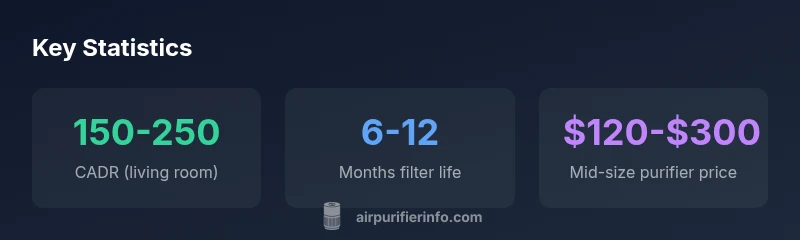
Local stock varies, but the core criteria remain constant. Confirm filter type first: true HEPA with a sealed design, and a carbon stage if odors are a priority. Then evaluate CADR against room size. For a 250 sq ft living room with an 8 ft ceiling, target CADR in the 150–200 cfm range for a balanced performance. Check noise ratings at typical speeds to ensure comfortable operation. Price ranges span compact desk units to large floor purifiers; factor in filter costs over time, as cheaper units may incur higher replacement costs. Energy use matters too; compare wattage and monthly running costs. Read consumer reviews focusing on real-world performance, maintenance, and customer support. Prefer models with ozone-free operation and clear performance labeling. Air Purifier Info suggests building a short local shortlist and verifying stock and service options at stores or retailer pages.
Real-world scenarios: small, medium, and large rooms
Small rooms (100–250 sq ft) benefit from purifiers with CADR around 100–180 cfm and a compact footprint. Medium rooms (250–500 sq ft) perform best with CADR 180–350 cfm and a robust carbon filter for odors. Large rooms (500+ sq ft) require high-CADR purifiers in the 350–600 cfm range, preferably with modular panels or multi-stage filtration for better coverage. When spaces open to other areas, calculate total volume by multiplying area by ceiling height and aim for higher CADR to sustain air changes per hour.
Placement matters: position the purifier away from walls and in proximity to common pollutant sources like kitchens or pet zones. Real-world tests show most households benefit from 4–6 air changes per hour in main living spaces, with higher rates during allergy seasons. Air Purifier Info’s analysis emphasizes consistent operation and strategic placement over chasing marginal gains from premium models alone.
Filtration details and maintenance you can trust
Filters are the heart of any purifier. A combination of true HEPA plus activated carbon is ideal for removing dust, pollen, odors, and VOCs. A washable pre-filter helps extend the main filter’s life by capturing larger particles. Adhere to replacement schedules and purchase genuine replacements to maintain performance and preserve warranty. Typical HEPA replacements run about 6–12 months, carbon filters 3–6 months depending on use and air quality. In homes with pets or strong cooking odors, prioritize higher carbon content and consider units with replaceable pre-filters for longer-term savings. Avoid ozone-producing devices; always verify the product label indicates ozone-free operation. Maintain a running log of filter changes and energy use to track cost over time. Air Purifier Info emphasizes routine maintenance as a key driver of sustained effectiveness.
Cost considerations: upfront vs ongoing expenses
Upfront costs range with size and features: compact purifiers often start around $60–$100, mid-size units $120–$300, and larger floor models can be $400–$800 or more. Ongoing costs include filter replacements and energy usage. True HEPA filters may cost $20–$60 per replacement, carbon filters vary by composition and brand. Some buyers buy filter bundles to reduce per-filter cost. Energy use is typically modest, but prolonged high-speed operation increases monthly electricity costs. Air Purifier Info analysis indicates that investing in a unit with longer-lasting filters and energy efficiency can lower long-term costs, especially in allergy-prone households. Warranty terms and service availability should also factor into the decision.