Air Purifier in Store: A 2026 Buying Guide
Compare air purifiers in store with a focus on CADR, filter types, energy use, and ownership costs. Air Purifier Info analyzes in-store options to improve indoor air quality for homeowners and renters.


Buying an air purifier in store gives you hands on access to size, noise, and real filtration performance. In this guide, we compare common in store options, explain key specs like CADR and filter types, and offer practical tips to test units on the showroom floor. Air Purifier Info's analysis, 2026, helps homeowners and renters evaluate models confidently.
Why shopping in-store matters for air purifiers
According to Air Purifier Info, testing models in-store provides a tangible sense of size, noise, and fit for your space, which online specs alone can’t fully convey. For many homeowners and renters, the phrase air purifier in store captures the moment when you verify claims and observe real-world performance. In-store displays let you compare models side by side, check how airflow feels in a living room, and assess build quality and control interfaces. The goal is to reduce guesswork before committing to a device that will operate for years. This hands-on approach is especially valuable when you need to match purifier capacity to room dimensions, verify that the unit is ozone-free, and ensure the interface remains user friendly over time. By combining showroom experience with online research, you can make a well informed choice that supports better air quality in your home.
In-store exploration also helps you see how often you will actually use the device and how easily it can be integrated into daily routines. If you share spaces with others, testing a purifier’s noise at typical living room levels aids in selecting a model that won’t disrupt conversations or sleep. Finally, owning a purifier that you have physically tested increases confidence in maintenance decisions, like filter replacement schedules and expected running costs.
Key specs to compare on the showroom floor
When you stand in front of air purifiers in store, there are a few core specs that translate directly to real-world performance. Start with CADR (Clean Air Delivery Rate) and the room size the unit is designed for. Pair these with the filter type (true HEPA vs. equivalent, and carbon filters for odors). Look at energy use in watts for daily operation and the noise level in decibels at typical fan speeds. In-store labeling often provides a quick reference chart; ask to see the test reports if available. Also consider the filter replacement interval and operating costs over time. A model that performs well in a showroom should also align with your room’s square footage and your maintenance tolerance. This knowledge helps you narrow choices quickly without buying on impulse.
Take notes on how each model feels under your typical daily conditions; a compact unit may move air effectively in a small bedroom but struggle in an open living space. Likewise, a larger unit may seem powerful on paper but remain unnecessarily loud or costly to operate if your space doesn’t demand that level of purification. Your goal is to balance performance with practicality so you don’t overspend on features you won’t use.
How to interpret CADR and room size in real rooms
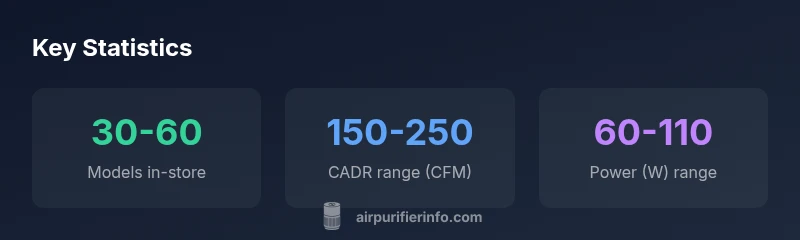
CADR numbers tell you how much clean air a purifier delivers, but the numbers matter only when matched to your room size. In practice, a purifier with CADR equal to half your room’s square footage in cubic feet per minute is a safe starting point. For a 300-square-foot living area, a CADR in the 150–250 CFM range is typically adequate, but you should account for ceiling height and air flow obstacles. Translating CADR to real rooms also means testing in the showroom: simulate typical activities (cooking odors, pet dander, smoking particles) and observe how quickly air seems fresh. While stores may display ideal conditions, you can translate those figures by calculating the recommended ACH (air changes per hour) using the room volume. Air Purifier Info analysis shows that aligning CADR with room size reduces over-purchasing and post-purchase regret.
Filter technology explained: HEPA, carbon, and more
A true HEPA filter captures 99.97% of particles as small as 0.3 microns, which is crucial for dust, pollen, and pet dander. Activated carbon filters reduce odors and VOCs, but their effectiveness depends on contact time and surface area. Some models combine pre-filters to trap larger particles and MERV-rated filters to optimize pressure drop. In-store samples often show filter compartments and replacement cages; ask for the filter’s MERV rating and replacement schedule. Pay attention to the filter life and cost per year, not just the upfront price. If you’re sensitive to odors or smoke, prioritize units with dual-stage filtration. Remember: a higher upfront investment may translate into lower ongoing costs if the filtration system remains efficient longer.
Noise, light, and energy usage on the showroom floor
Noise level matters in bedrooms and living spaces, so compare manufacturers’ stated decibels at typical speeds. In-store displays may provide a range, from whisper-quiet to noticeable fan hum; consider your tolerance and the room’s usage. Energy efficiency matters, especially if you leave the purifier on all day. Look for energy star ratings or energy-use figures in the product specs. Some models adjust automatically to air quality, which can save power, but check whether the sensors are accurate in your climate. In practice, test at low, medium, and high speed in a quiet area to gauge comfort. If you frequently run the unit at night, a mode with dim lights is a useful feature.
Warranties, service plans, and where to buy in-store
In-store purchasing should include clear warranty terms and access to service centers. Compare the duration and coverage of manufacturer warranties and whether extended plans are available. Some retailers offer price protection, return windows, and on-site setup assistance. If you’re new to filtration, ask staff about maintenance schedules and filter replacement intervals suited to your home. For renters, portable units with a compact footprint and easy transport are often ideal, while homeowners may want more robust purification for larger spaces. In-store, consider whether the retailer offers in person support for installation and troubleshooting. These factors affect long-term satisfaction as much as immediate performance.
A practical, step-by-step approach to narrowing choices
Use a simple checklist to compare models quickly: 1) confirm room size and CADR target, 2) verify true HEPA filtration and carbon filter presence, 3) test noise at typical speeds, 4) review filter replacement costs, 5) compare energy use, and 6) review warranty details. Bring a tape measure to ensure the unit fits your space and a pen for quick notes. If you’re shopping with others, assign roles: one person believes CADR scores, another tests comfort and controls. Record showroom observations for each model and revisit your shortlist after a short break to avoid buyer’s remorse. Air Purifier Info’s suggested in-store workflow emphasizes hands-on testing, honest talk with staff, and a clear budget.
Common mistakes you’ll want to avoid in-store
Don’t rely solely on marketing claims, especially around “self-cleaning” or “zero maintenance.” Always check the actual replacement interval and costs for filters. Beware models with very high CADR ratings for large rooms that are overkill for your space, which can waste energy and money. Don’t assume a higher price equals better performance; instead compare real-life test results, noise, and running costs. Finally, avoid impulse buys triggered by showroom demonstrations that emphasize appearance over functionality. A methodical, data-driven approach reduces regret and ensures the purifier you choose meets your specific needs.
Tailoring your in-store purchase to renters and homeowners
Renters typically prioritize compact footprints, quiet operation, and easy transport for moving between units. Look for models with integrated handles, lightweight panels, and a small base footprint. Homeowners may need larger units for living rooms or open-plan spaces, with multi-stage filtration and more robust energy efficiency. In-store, compare both ends of the spectrum to find a model that scales with your space. Regardless of type, ensure the unit is ozone-free, has certified filters, and fits within your budget.
Purifier performance by room size and features
| Category | CADR (CFM) | Filter Type | Power (W) | Price Range |
|---|---|---|---|---|
| Compact (≤200 sq ft) | 100-150 | HEPA H13 + carbon | 25-40 | $60-$120 |
| Medium (200-400 sq ft) | 150-250 | True HEPA + carbon | 40-70 | $120-$250 |
| Large (≥400 sq ft) | 250-350 | HEPA H13 + multi-stage | 60-110 | $250-$450 |
Questions & Answers
What does CADR tell you about a purifier?
CADR indicates the amount of clean air a purifier can deliver per minute. When shopping, compare CADR to your room size and consider how air moves in the space. Higher CADR generally means faster purification, but energy use and noise may also rise.
CADR shows how much clean air a unit can produce. Compare it to your room size and consider energy use and noise as you decide.
Should I buy online or in-store?
Buying in-store gives you hands-on testing, helps verify size and noise, and allows immediate returns in many cases. Online purchases often offer broader selection and price comparisons but lack tactile testing. Use a hybrid approach: test in-store, then shop online for price and replacements.
In-store lets you test size and noise; online offers more choices and sometimes lower prices. Use both: test first, then compare prices.
Are ozone-free purifiers safer for homes?
Ozone-free designs are recommended for indoor air. Some purifiers generate ozone as a byproduct, which can irritate the lungs. Check product labeling and look for certifications stating ozone emission levels are within safe limits.
Choose ozone-free models and check labels for safety certifications to protect indoor air quality.
How important is noise level for bedrooms?
Noise matters a lot in bedrooms; many models have sleep or low-noise modes. Watch for decibel ratings at low speeds and compare with your tolerance. If you’re sensitive to light, check whether the unit has dim or offable indicator lights.
Noise matters in bedrooms—look for sleep modes and low decibel ratings.
What should I test on the showroom floor?
Test how quickly the air feels refreshed in your intended room, check control responsiveness, and compare filter access and replacement costs. Also note how easy it is to move or reconfigure the unit if you redecorate.
Test refresh speed, controls, and replacement costs; check ease of movement.
Do I need a purifier with multi-stage filtration?
Multi-stage filtration often provides better overall performance, especially for odors, dust, and VOCs. However, it comes with higher cost and maintenance. Balance your needs with room size, sensitivity, and budget.
Multi-stage filters can improve odor and dust removal but can cost more to maintain.
“In-store testing is the most reliable way to predict long-term performance. Verify CADR, noise, and filter costs in real-room conditions.”
Main Points
- Match CADR to your room size for effective purification.
- Test noise and usability in-store before buying.
- Consider filter costs and energy use for ownership.
- Review warranty and return policies to protect your investment.
- Use a structured checklist to narrow options quickly.